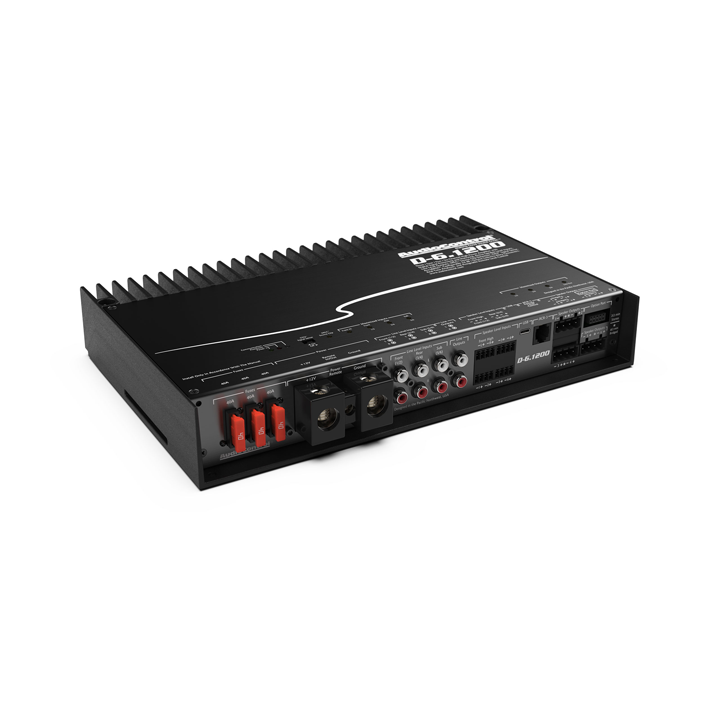

A fuse costs less than a fast food meal, yet it is the one part of an amplifier install that decides whether a short circuit ends with a blown fuse or a melted power wire behind your dashboard. Most people grab whatever fuse comes in the box or guess based on the amp's wattage sticker. Both approaches can leave the wire unprotected or cause the fuse to pop every time the bass hits. This guide shows you exactly how to size an inline fuse for car audio, gives you a ready-to-use amplifier fuse size chart, and explains which fuse type fits your build.
What the Main Fuse Actually Protects
Here is the part almost everyone gets wrong. The main inline fuse near your battery is not there to protect the amplifier. It is there to protect the power wire and your vehicle. If that wire ever rubs through on sharp metal and touches the chassis, the battery will push hundreds of amps through it instantly. Without a properly sized fuse, the wire heats up, the insulation melts, and you have a fire risk.
The amplifier has its own protection, usually fuses built into the chassis or an internal protection circuit. That's why the rule in car audio is simple. The main fuse is sized to the wire, and the wire is sized to the amplifier's current draw. Get those two matched and the rest of the system is protected.
How to Calculate What Size Fuse for Amp Installs
You don't need to be an electrician to size a fuse correctly. The math uses three numbers you can find on any amp's spec sheet.
Step 1. Find the total RMS power. Add up the RMS output of every channel at the impedance you'll actually run. A 4-channel amp rated 100W x 4 has 400 watts RMS total. Ignore peak or "max" numbers completely. If you're unsure which number to trust, our guide on RMS vs peak power explains it clearly.
Step 2. Account for efficiency. Amplifiers waste some power as heat. Class D amps are roughly 80% efficient, while Class A/B amps run closer to 50 to 60%. Divide the RMS total by the efficiency to find how much power the amp pulls from your electrical system.
Step 3. Convert to amps. Divide that number by your system voltage, about 13.8 volts with the engine running. The result is the amp's approximate current draw, and your fuse should be the next standard size above it, as long as the wire can safely handle that rating.
Here's what that looks like for a 1000 watt RMS Class D monoblock:
1000 ÷ 0.80 = 1250 watts drawn
1250 ÷ 13.8 = about 91 amps
Next standard size = 100 amp fuse
Amplifier Fuse Size Chart
The chart below uses Class D efficiency at 13.8 volts, which covers the majority of modern amplifiers. Wire recommendations assume true gauge OFC copper on runs under about 20 feet. If you're using CCA wire, go up one wire size.
| Amp RMS Power | Approx. Current Draw | Recommended Fuse | Minimum Power Wire (OFC) |
|---|---|---|---|
| 300 watts | 27 amps | 30 to 40 amp | 8 gauge |
| 500 watts | 45 amps | 50 to 60 amp | 8 gauge |
| 750 watts | 68 amps | 80 amp | 4 gauge |
| 1000 watts | 91 amps | 100 amp | 4 gauge |
| 1500 watts | 136 amps | 150 amp | 4 gauge (short run) or 1/0 |
| 2000 watts | 181 amps | 200 amp | 1/0 gauge |
| 3000 watts | 272 amps | 250 to 300 amp | 1/0 gauge |
| 4000 watts | 362 amps | Split across dual 1/0 runs | Dual 1/0 gauge |
Running a Class A/B amp? Expect roughly 30 to 50% more current draw than the chart shows, so size the wire and fuse up accordingly. Another quick reference is the amp's own onboard fuses. If an amp has two 40 amp fuses on the chassis, the main fuse should be around 80 amps, provided your wire is rated to carry it.
Important Note: Never install a fuse larger than your power wire can handle, even if the amplifier draws more current. If a 1500 watt amp needs 150 amps but you only ran 8 gauge wire, the problem isn't the fuse. It's the wire, and it needs to be upgraded before the system goes back on.
The Right Fuse for a 1000 Watt Amp
The fuse for a 1000 watt amp is one of the most searched questions in car audio, and for good reason. It's the most popular monoblock size for a single or dual subwoofer setup. For a Class D amp like the AudioControl EPIC1000, a 100 amp fuse paired with 4 gauge OFC wire is the correct combination.
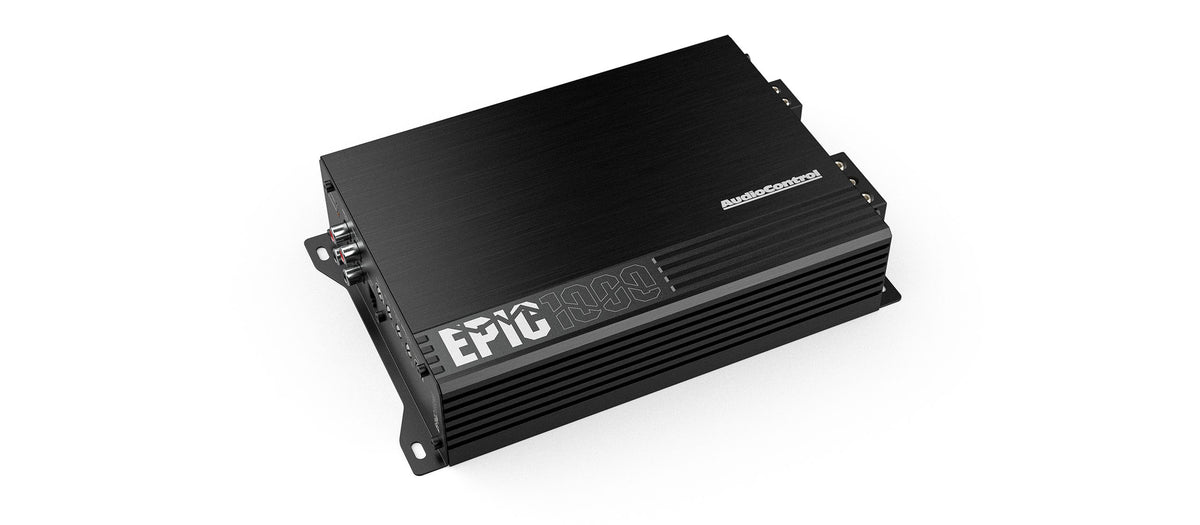
The easiest way to get this right is a complete kit. The Elite Audio EA-PRMK4 4 Gauge Amp Kit at $65.99 includes CCA wire and a Mini ANL fuse holder, which makes it a good fit for moderate systems up to around 750 watts RMS. For a true 1000 watt build, the Elite Audio EA-PROK4 Pro Series 4 Gauge OFC Kit at $210.99 uses 100% copper true gauge wire that safely carries a 100 amp fuse. You can read why that matters in our breakdown of OFC vs CCA wire.
If you're running something bigger, the EA-PROK0 Pro Series 0 Gauge Kit at $264.99 handles high-power monoblocks, and the EA-PROK0-DUAL Kit at $229 is built for two-amp systems.
ANL vs AGU Fuse, Which Type Should You Use?
The ANL vs AGU fuse question comes down to current, reliability and how much space you have. All of these fuse types do the same job, but they handle heat and vibration very differently.
| Fuse Type | Typical Range | Connection | Best For |
|---|---|---|---|
| AGU (glass tube) | Up to about 60 to 80 amps | Spring clip contacts | Small amps and older installs |
| Mini ANL | About 30 to 150 amps | Bolt-down terminals | Most single-amp systems |
| ANL | About 50 to 300+ amps | Bolt-down terminals | High-power and multi-amp builds |
AGU Fuses
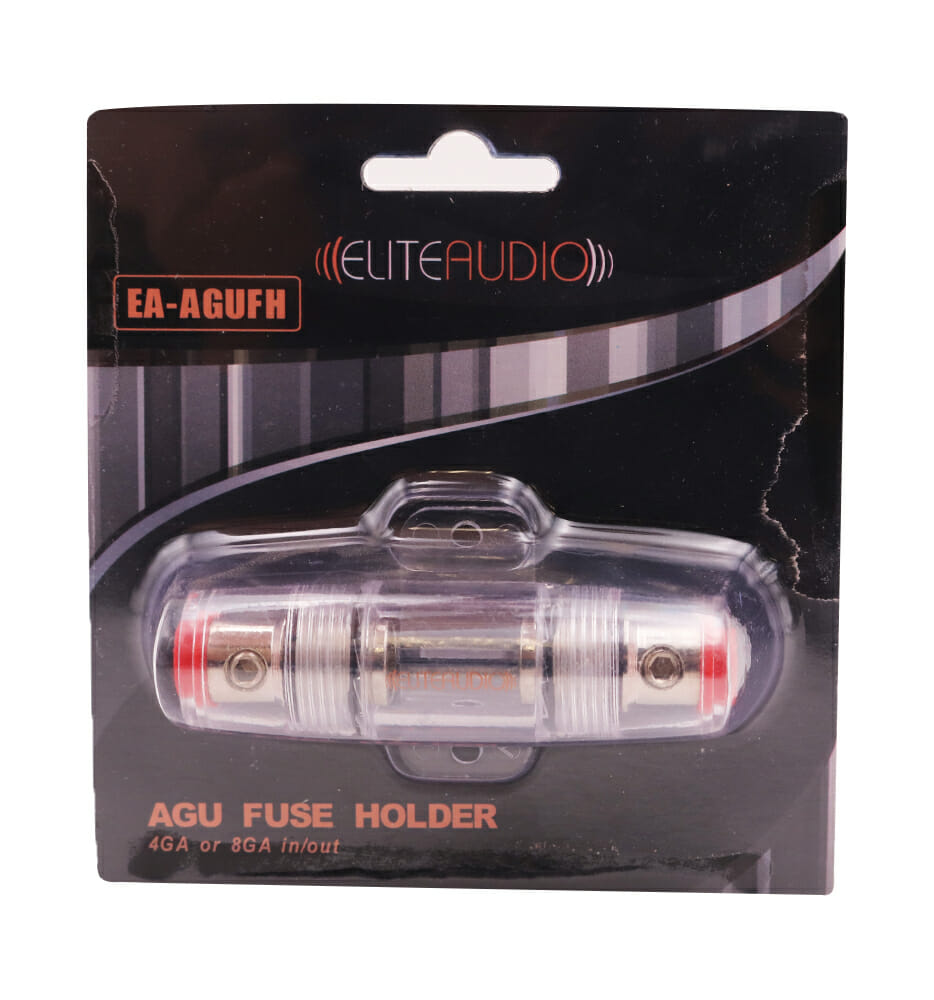
AGU fuses are the glass tube style you'll see in many older installs and entry-level kits. They're inexpensive and easy to find, but the spring clip contacts can loosen with vibration and build heat over time. That added resistance can drop voltage to the amp. They work fine for smaller amplifiers under about 60 amps. The Elite Audio EA-AGU Nickel Plated AGU Fuses and matching EA-AGUFH AGU Fuse Holder are both $14.99.
Mini ANL Fuses
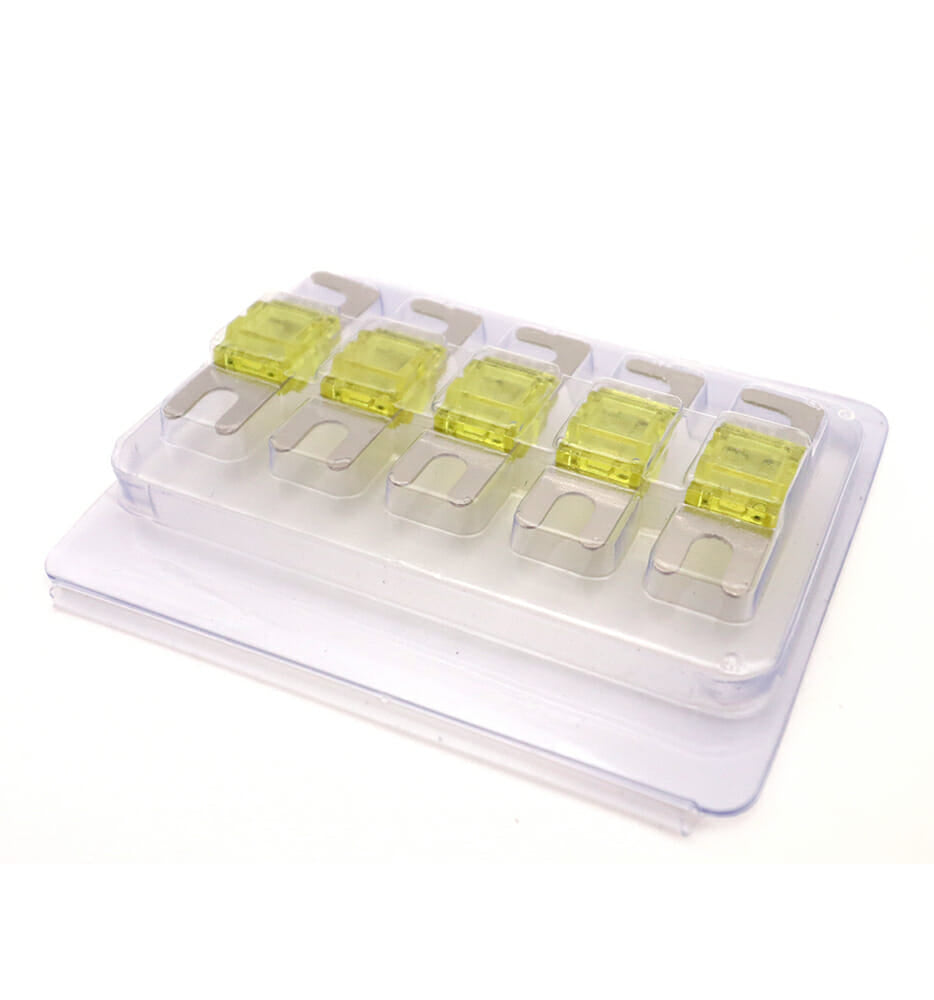
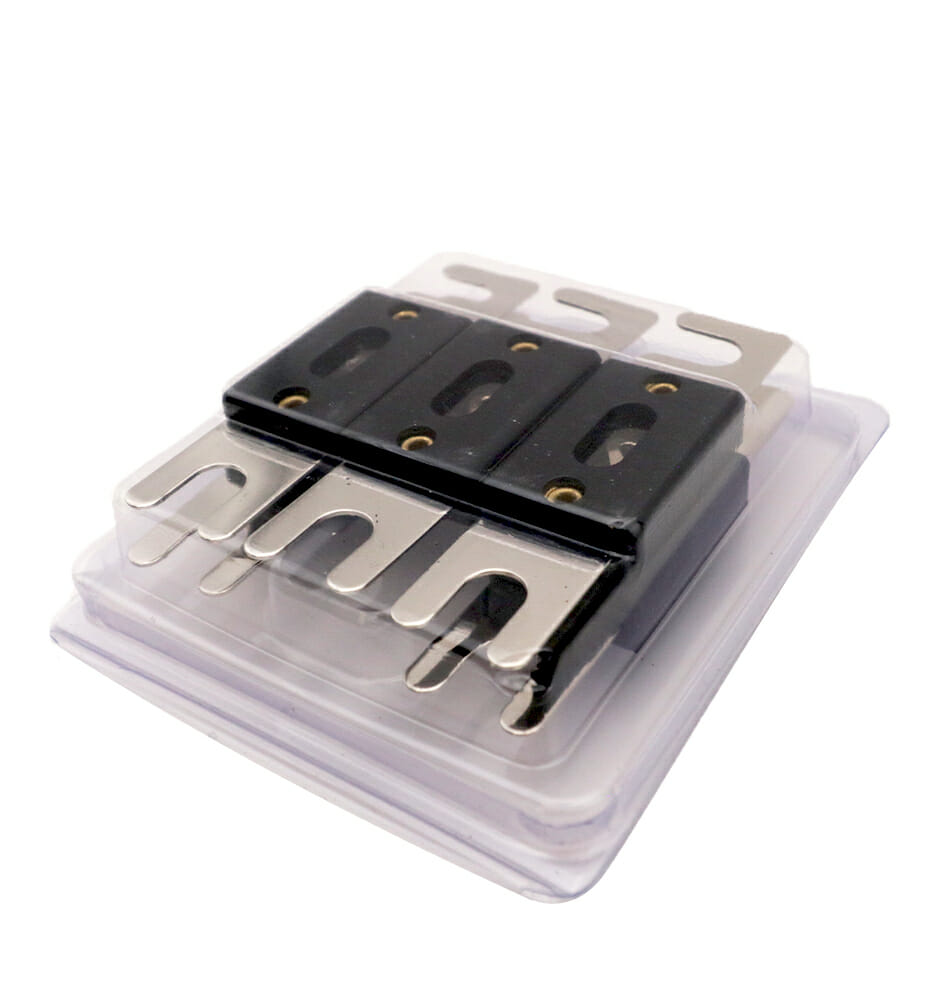
Mini ANL is the sweet spot for most car audio systems. The fuse bolts down at both ends, so the connection stays tight and cool even on bumpy roads. The compact holder also fits easily in crowded engine bays. Pick up the Elite Audio EA-MANL Mini ANL Fuses for $14.99 and the EA-MANLFH-02 Mini ANL Fuse Holder for $14.99.
ANL Fuses
Full-size ANL fuses are the go-to choice once you pass roughly 150 amps or run multiple amplifiers. They handle serious current with very little resistance, which is why competition and high-SPL builds use them almost exclusively. The Elite Audio EA-ANL Nickel Plated ANL Fuses are $14.99. Check each product page for the amperage options currently available.
Pro Tip: Nickel plated fuses and holders resist corrosion much better than bare brass, which matters in engine bays that see heat, moisture and road salt. For boats, side-by-sides and Jeeps that get wet, a sealed holder like the DS18 DS-MFH4 Marine Fuse Holder, now $19.95 (was $24.99), keeps water away from the connection.
Where to Install the Inline Fuse
Fuse placement matters as much as fuse size. The main fuse should sit within 18 inches of the battery's positive terminal. Any wire between the battery and the fuse is unprotected, so the shorter that section is, the safer your install.
Mount the fuse holder somewhere solid where it won't vibrate loose or touch moving parts. Route the power wire through a factory grommet or a properly protected hole in the firewall, never through bare sheet metal. Install the fuse last, only after every connection at the amplifier is finished and checked.
Fusing Multiple Amplifiers
When you run two or more amps from one power wire, you need a main fuse at the battery plus a secondary fuse for each amp at a fused distribution block. The main fuse protects the large wire from the battery, and each smaller fuse protects the smaller wire going to each amp. Size every secondary fuse to that amp's current draw and the wire feeding it.
Big 3 Upgrade Fusing
If you're upgrading the charging wires under the hood, the alternator to battery positive wire should be fused as well. The Elite Audio EA-PROK0-BIG3 Upgrade Kit at $199 includes 0 gauge tinned copper wire for this job. A Big 3 upgrade is one of the best ways to reduce headlight dimming and keep voltage stable on systems above 1000 watts.

Building Your Own Wiring Setup
Some installers prefer buying wire and fuses separately to get exact lengths or mix brands. If that's you, match each piece carefully.
- Power wire. The Elite Audio EA-PRM4G-PWR 4 Gauge CCA is $89 for 100 feet, while the EA-PRO-4G-PWR 4 Gauge OFC is $269 for 100 feet. For big builds, the EA-PRO-0GPWR 0 Gauge OFC is $289 for 50 feet.
- Ground wire. Always use the same gauge as your power wire. The EA-PRM4G-GRND 4 Gauge is $89 and the EA-PRM0G-GRND 0 Gauge is $109.99.
- Smaller systems. The Elite Audio 8 AWG Ground Cable is on sale at $75.65 (was $89), and the EA-PRM8G-PWR 8 Gauge Power Wire is $89 for 200 feet.
Everything else you need, including remote wire, ferrules and RCA cables, is in the Accessories and Wires collection.
Why Your Amp Fuse Keeps Blowing
A fuse that blows repeatedly is a warning, not a nuisance. Replacing it with a bigger fuse is the most dangerous fix you can try, because it removes the protection without solving the problem.
The most common causes are a power wire that is touching metal somewhere, a loose or rusty ground connection, a fuse that is simply undersized for the amp's actual current draw, or an internal amp fault. Speaker wires shorting against each other or the chassis can also overload the amp. Check the full wire run first, then the ground point, and only then look at the amp itself.
Pro Tip: If the fuse is fine but the amp keeps shutting down or flashing a red light, the issue is usually voltage, grounding or impedance rather than the fuse. Our guide on why an amp goes into protect mode walks through each cause step by step.
Frequently Asked Questions
What size fuse do I need for a 500 watt amp?
A 500 watt RMS Class D amp draws about 45 amps, so a 50 to 60 amp fuse with 8 gauge OFC wire or 4 gauge CCA wire is the right choice. If the amp is Class A/B, plan on closer to 80 amps and 4 gauge wire.
Can I use a bigger fuse than recommended?
Only if your power wire is rated to carry that higher current. A fuse larger than the wire's capacity won't blow before the wire overheats, which defeats the purpose of having a fuse. When in doubt, size the fuse to the wire.
Do I need to fuse the ground wire?
No. The ground wire should never be fused. It connects directly from the amplifier to a clean, bare metal point on the vehicle chassis, as close to the amp as possible. Only the positive power wire gets a fuse.
Is the fuse on my amplifier enough?
No. The amplifier's onboard fuses protect the amp's internal circuits, but they're located at the end of the power wire. Without a main inline fuse at the battery, the entire wire run back to the amp is unprotected against a short.
Should I use an ANL or Mini ANL fuse for a 1000 watt amp?
Either works well at 100 amps. Mini ANL is more compact and fits most engine bays easily, which makes it the common choice for single-amp systems. Full-size ANL makes more sense if you plan to add a second amp later or move up to a system above 1500 watts.