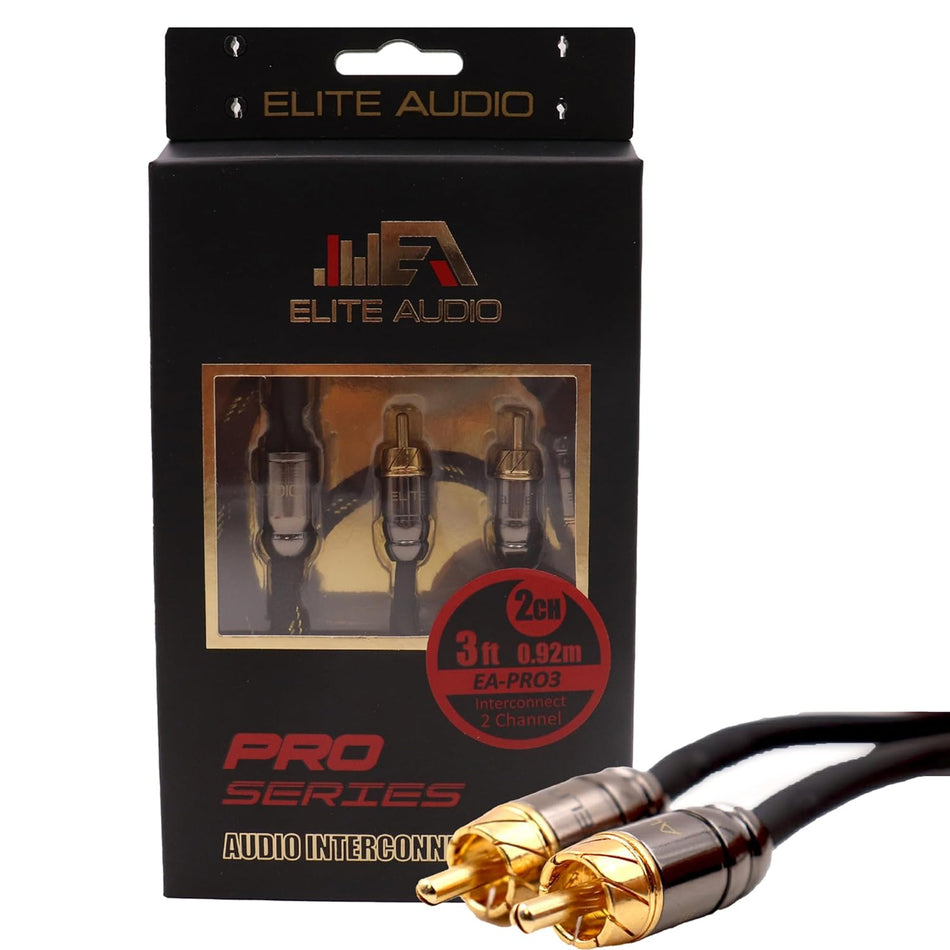

Ask ten installers what gauge speaker wire to run and you will get answers ranging from "16 is fine for everything" to "never go below 12." Both camps are confident, and both are partly right, because they are quietly talking about different parts of the system.
The honest version is less exciting than either. For most door speakers, the gauge argument is close to meaningless and the difference between 16 and 14 measures in hundredths of a decibel. For subwoofers running at low impedance, gauge is one of the few things that genuinely changes what you hear. Same wire, same physics, completely different conclusion, and the variable that decides it is impedance.
Speaker Wire Carries Less Current Than People Assume
Power wire and speaker wire get discussed as if they face the same problem. They do not. A power cable feeding a 1000 watt amplifier carries roughly 85 amps continuously at 13.8 volts, which is why gauge is critical there and why the OFC vs CCA question matters so much on that side of the amp.
Speaker wire carries the amplifier's output, which is a different situation entirely. Current there follows from power and impedance, and for a typical door speaker it stays small. A 100 watt channel into a 4 ohm speaker moves 5 amps. Even at full tilt, that is well within what thin wire can handle without heating.
A subwoofer changes the picture. Push 1000 watts into a 1 ohm load and you are moving over 31 amps through that pair of conductors. Same wire, six times the current, and suddenly the resistance of the cable stops being a rounding error.
The Rule That Settles Most Arguments
There is a working standard installers use, and it is simple enough to calculate in your head. Total speaker wire resistance should stay below 5% of the speaker's nominal impedance. Some builders tighten it to 2% for subwoofers.
The reason the rule works is that your wire and your speaker form a voltage divider. Power lost in the wire is its resistance divided by the total, so a wire measuring 5% of speaker impedance costs you about 5% of your power, which comes to roughly 0.2 dB. That is below what anyone can hear.
Two details trip people up when they calculate this. First, resistance is round trip, so a 12 foot run means 24 feet of conductor. Second, the impedance that matters is the actual load, not the number printed on the speaker box. A pair of 4 ohm drivers wired in parallel presents 2 ohms, which halves your allowable wire resistance instantly.
Resistance by Gauge and Length
These are the figures behind every recommendation that follows, for pure copper conductor.
| Gauge | Resistance per foot | Round trip resistance, 10 ft run | Round trip, 20 ft run |
|---|---|---|---|
| 18 AWG | 0.00639 Ω | 0.128 Ω | 0.256 Ω |
| 16 AWG | 0.00402 Ω | 0.080 Ω | 0.161 Ω |
| 14 AWG | 0.00253 Ω | 0.051 Ω | 0.101 Ω |
| 12 AWG | 0.00159 Ω | 0.032 Ω | 0.064 Ω |
| 10 AWG | 0.00100 Ω | 0.020 Ω | 0.040 Ω |
Copper clad aluminum runs roughly 60% higher resistance than these numbers at the same gauge, so treat CCA speaker wire as two gauge sizes thinner than its label.
Car Speaker Wire Chart: Maximum Run Length by Impedance
Combining the 5% rule with those resistance values gives the actual answer to "what gauge do I need." Find your load impedance, find your run length, and read off the gauge.
| Load impedance | 18 AWG | 16 AWG | 14 AWG | 12 AWG | 10 AWG |
|---|---|---|---|---|---|
| 8 ohm | 31 ft | 49 ft | 79 ft | 126 ft | 200 ft |
| 4 ohm | 15 ft | 24 ft | 39 ft | 62 ft | 100 ft |
| 2 ohm | 7 ft | 12 ft | 19 ft | 31 ft | 50 ft |
| 1 ohm | 3 ft | 6 ft | 9 ft | 15 ft | 25 ft |
Each figure is the longest one-way run that keeps wire resistance under 5% of the load. Notice how the 4 ohm row is generous and the 1 ohm row is brutal. That single contrast is the whole point of this article.
For context, a typical front door run in a sedan is 8 to 12 feet from the amplifier. Rear doors add a few feet. A trunk-mounted amp to a subwoofer sitting beside it might be 3 feet, while the same amp to a sub under a rear seat could be 6 to 8.
16 vs 14 Gauge Speaker Wire: The Honest Comparison
This is the most searched version of the question, so it deserves real numbers rather than opinion. Take a 12 foot run to a 4 ohm door speaker, which describes a large share of installs.
| 16 AWG | 14 AWG | |
|---|---|---|
| Round trip resistance | 0.096 Ω | 0.061 Ω |
| Percentage of 4 ohm load | 2.4% | 1.5% |
| Power lost in the wire | 2.3% | 1.5% |
| Level difference | 0.10 dB | 0.06 dB |
The gap between them is 0.04 dB. Human hearing struggles to detect a 1 dB change under ideal conditions, and this is twenty-five times smaller than that. Anyone claiming they heard their door speakers improve after swapping 16 for 14 gauge on a run that length is describing an expectation, not an audible difference.
That does not make 14 gauge a waste. It costs a few dollars more per run, gives you headroom if you later go active or add a second driver per door, and is more physically robust when pulled through a door boot. Buying it is reasonable. Expecting it to sound different at 4 ohms is not.
Pro tip: where 16 versus 14 genuinely matters is at 2 ohms or lower. Drop that same 12 foot run onto a 2 ohm load and 16 gauge sits at 4.8% while 14 gauge sits at 3%. Now you are at the edge of the rule instead of comfortably inside it.
Speaker Wire for Subwoofers Is a Different Job
Subwoofer wiring deserves its own thinking, and 12 gauge should be your floor regardless of what the calculator says. Three separate reasons stack up.
The first is current. Low impedance loads mean high current, and the 1 ohm row in the chart above shows how quickly your allowable length collapses. A 1000 watt monoblock on a 1 ohm load with 16 gauge wire will exceed the 5% threshold before the wire even leaves the trunk.
The second is damping factor, which is the amplifier's ability to control cone motion after the signal stops. It is calculated from load impedance divided by the total source impedance, and your speaker wire adds directly to that source impedance. An amp with an excellent damping factor of 200 connected through wire measuring 0.08 ohms on a 1 ohm load drops to an effective figure near 12. That loss of control shows up as bass that sounds loose and slow rather than tight, which is one of the causes behind speakers sounding distorted even when nothing is technically broken.
The third is heat. Thirty amps through 16 gauge wire coiled behind a trunk panel warms the conductor, and warm copper has higher resistance than cool copper, so the problem compounds as you play. Before finalising any sub wiring plan, confirm the final load with a wiring diagram rather than assuming, since the difference between arrangements is covered in 4 ohm vs 2 ohm speakers.
Recommended Gauge by Application
| Application | Typical load | Recommended gauge |
|---|---|---|
| Head unit powered door speakers | 4 ohm | 18 or 16 AWG |
| Amplified door speakers, under 75W RMS | 4 ohm | 16 AWG |
| Amplified door speakers, 75 to 150W RMS | 4 ohm | 14 AWG |
| Active front stage, separate tweeter and midbass | 4 ohm | 14 AWG |
| Component midbass in a high power build | 2 ohm | 14 or 12 AWG |
| Single subwoofer, up to 500W RMS | 2 to 4 ohm | 12 AWG |
| Single subwoofer, 500 to 1000W RMS | 1 to 2 ohm | 12 or 10 AWG |
| Multiple subwoofers or over 1000W RMS | 1 ohm | 10 AWG or heavier |
Matching wire to the power the amplifier actually produces, rather than to peak numbers on a box, keeps this simple. Working out that real figure is covered in RMS vs peak power.
Where Wire Choice Actually Goes Wrong
Gauge attracts all the attention while the real failures happen elsewhere. Three problems cause far more audible damage than choosing 16 over 14 ever will.
Poor terminations top the list. A twisted joint wrapped in electrical tape corrodes, and a corroded connection can develop more resistance than an entire run of undersized wire. Crimp with proper connectors, use adhesive lined heat shrink, and avoid soldering at the speaker terminal where vibration eventually cracks the joint.
Polarity mistakes come second. One speaker wired backward puts it out of phase with the rest, cancelling midbass and hollowing out the centre image. It sounds like a system problem and it is a wiring problem, and the symptoms overlap heavily with what is described in how audio phase affects bass and clarity.
Routing is third. Speaker wire run alongside power cable or across the ECU harness picks up alternator whine and engine noise, particularly on longer runs. Keep speaker and power wiring on opposite sides of the vehicle wherever the layout allows, and use grommets at every metal pass-through. These and similar oversights appear in top mistakes to avoid in car audio installation.
What About Oxygen Free Copper for Speaker Wire?
The OFC versus CCA question applies here too, though with lower stakes than on the power side. CCA speaker wire carries about 1.6 times the resistance of copper at the same gauge, which on a 4 ohm door run is a difference you will not hear.
Where CCA hurts is at low impedance and at the terminations. Aluminum oxidises into an insulator, and it cold flows under the pressure of a set screw, so connections loosen on their own over time. On a subwoofer running 30 amps, a slowly loosening terminal is a real problem rather than a theoretical one.
Practical compromise: CCA is acceptable for door speakers on short runs if you crimp and seal properly. For subwoofers, anything at 2 ohms or below, and any run you would rather not revisit, use copper. The full argument sits in why cheap wiring can ruin high end speakers.
Things That Do Not Matter as Much as Marketing Suggests
Strand count affects flexibility and durability, not sound. Skin effect, the phenomenon that pushes high frequency current toward the outer surface of a conductor, is real but only becomes relevant at radio frequencies. At 20 kHz in a conductor this size, it is negligible.
Directional speaker wire, cryogenic treatment, and exotic insulation materials have no measurable effect in a vehicle where road noise sits at 65 to 75 dB. Money spent there returns nothing, while the same money spent on sound deadening or a better crossover returns something you can hear immediately.
Equal length runs to left and right speakers is another idea worth right-sizing. The theory is sound, but a two foot difference in a 4 ohm run changes level by about 0.02 dB, far less than the seating position asymmetry every car already has. Genuine imaging improvements come from placement and tuning instead, as covered in best car speaker placement for maximum soundstage.
Frequently Asked Questions
Does speaker wire gauge really matter? It matters at low impedance and long runs, and barely matters for standard 4 ohm door speakers on runs under 20 feet. Subwoofer wiring is where the choice becomes audible.
Is 16 gauge speaker wire enough for car audio? Yes for 4 ohm door speakers on runs up to about 24 feet. Not for subwoofers, and not for anything running at 2 ohms or lower over any real distance.
Can speaker wire be too thick? Electrically no, but oversized wire is stiffer, harder to route through door boots, and often will not fit standard speaker terminals or crossover blocks. Going two sizes past what the chart recommends adds cost without benefit.
Does longer speaker wire reduce sound quality? Only through added resistance, and the effect is proportional. Doubling length doubles resistance, so a run that measures 2% of impedance at 10 feet becomes 4% at 20 feet, which remains inaudible on a 4 ohm load.
What gauge speaker wire for a 1000 watt subwoofer? At 1 ohm, use 10 gauge for any run beyond a few feet. At 2 ohms, 12 gauge covers most trunk installs comfortably.
Should front and rear speakers use the same gauge? Not necessarily. Rear speakers usually run at reduced level as ambience, so 16 gauge is generally sufficient even on longer runs, as discussed in rear fill and whether you need rear speakers.
Putting It Together for Your Build
Work out your actual load impedance first, measure the run with a tape rather than guessing, then read the gauge off the chart and go one size thicker if the number lands near the edge. That sequence takes five minutes and removes the entire debate.
For most people the outcome is unremarkable: 16 gauge to the doors, 12 gauge to the sub, copper conductor, crimped terminations, and routing kept away from power cable. Anyone comparing options across the Elite Auto Gear wiring range will find that spending the extra money on the subwoofer run and staying sensible on the doors produces a better result than putting expensive wire everywhere.
The wire is not where the magic happens. It just needs to stay out of the way, and now you know exactly what that takes.